Showing posts with label Economy Fixes. Show all posts

Friday, 25 May 2012

Pennies and Dimes and the 99%

It was this time last year that I fell out of love with London.  I was staying in a three story walk-up flat, in Kensington.  Close to shops, tube, and some great pubs.  And walking distance to the Chelsea Flower Show and Q&A amongst other museums.  From my bower window I could sit in the afternoon spring sun and watch the pedestrians far below, hithering and thithering.

Kensington was dirty, and the people grasping.  The young women wore stiletto heals that were reminiscent of the foot binding days of the Chinese.  All the shops had sales, although I am not a shopper, it was noticeable that along the strip the retailers were doing it tough.  Clear signals of a weak economy. 

The fact that it rained most of the week could have also contributed to my gloom.  In one day alone we had boiling heat, torrential and flooding thunderstorm, hail, and a wind storm.  

Across the street from my flat, and a floor lower was a gorgeous apartment.  Decorated and furnished in the old English style it was immaculate, with real old world charm.  The curtains were always open as though the owner was inviting people to glance in and admire.  

The owner himself was of old world charm style, an English gentleman.  Maybe ex military, because he stood tall and ramrod straight despite his clearly many years, and groomed to within an inch.  

As I sat in the evening, it was the only time I saw him, despite having a clear view the entire length of his apartment.  At that time, he would sit beside the window and read the paper, on occasion leaning into the window as the light faded, holding up the paper.  

Maybe I am slow, but it took a few days to realise that he was using daylight to read by rather than turn on an overhead light.  And further, that I at no time when glancing out the window saw lights – either overhead or from a flickering TV – in the evening.  In the kitchen, I only ever saw tin cans on the bench, despite the inviting décor.  It took me a little time to understand that all over London some, like this elderly gentleman living in a million pound apartment, and others less fortunate, were not turning on the lights nor cooking, because they couldn’t afford it from their income.  I wasn’t just the poorer demographic.  The seemingly wealthy were suffering also.  

And maybe like this gentleman, they lived a proud existence, and told nobody for the shame.

I have written about inflation and ivory towers, in which I suggested that the governments would soon (and again) be adjusting how they measure inflation to grab back money on say, pensions.  Inflation is a number on which the whole world spins, whether measuring real investment returns, pensions adjustments, or planning for future expenditure.  

And that the western economies are experiencing stagflation, whereby the cost of essentials – food, water, energy, healthcare – are rising faster than the income on which we rely to meet these essentials.  And I don’t see how it is going to be any better for decades.  (I took my own advice and bought a farm.)

Then a month ago there was this extraordinary article, as if to prove me completely correct.  So that I am sure you have the benefit of reading it (and the following comments) here is the link in full.


I learnt various things from this article.  First, that Bloomberg now had its own editors publishing editorials.  When did that happen?  Second, that they also posted comments about an editorial.  Again, since when?  Third that Bloomberg is still getting its facts wrong.  Evan when written by the “editors” themselves, whose primary role is, after all, to edit the facts.  

Here is the opening line:  Sadly, Congress and the White House seem incapable of agreeing on substantive measures to tackle the $10.4 trillion mountain of U.S. debt.”

Now the interesting thing about that line, is that the US debt is in fact US$15 trillion, because I looked it up on Bloomberg.  

The article then goes on (the “slam dunk” in the heading is a tip to its quality) to say that the government should switch to a Chained Inflation measure rather than the standard measure used today.  

Chained inflation is a measure, that reputedly tracks changes in consumer purchasing behaviour.  The example they use is that when the price of a granny smith apple rises, the consumer switches to the lower cost red delicious apple.  

Now, for sure you are getting the drift.  As inflation on food essentials (as an example) keeps rising, people will continuously switch to lower and lower cost products.  Cat food comes to mind, as it did to the many commentators who overwhelmingly mocked this article.  Dog bones anybody?  What inflation?

The “editors” suggested that this would save the government US$300 billion over ten years.  No suggestion how this was going to pay down the debt.  And at 0.2% it isn’t even enough to pay the interest on the debt. 

And you guessed it, the savings came from:  social security and cost of living adjustments;  pensions; and probably food stamp recipients.  The 99%. 

And again this turns to a continuing theme in this blog – penny and diming the 99% whilst the 1% carry on.  As pointed out in prior blogs, taxing the OTC derivative market, US$700 trillion and counting, just 0.1%, would raise US$700 billion.  And if the duration of the OTC market is 3 months, that would be US$2.8 trillion per year, or enough to pay off the USA debt in total plus a huge surplus using Bloomberg’s 10 year measure.  

Of course the USA is not the home to all the global derivatives, but probably a lot of them.  There would be quite a material amount in other financial centres such as London.  

And you guessed it, the Telegraph reports that that government is about to pennie and dime its citizens by adjusting how the RPI is measured.  That's the retail price index.

It reports “A reduction in RPI would save the Government up to £3bn a year on the interest payments it makes on index-linked gilts, but would also slash income for pensioners and those whose pay packages are linked to the measure.”

Like the pension for that charming elderly gentleman living in Kensington.  Or should I say, surviving, just! 

Monday, 7 May 2012

Right Not to Trust (the Fed)


So we have been writing about the massive excessive reserves of the USA banks held with the Fed Reserve.  At an official rate of 0.25% (in the "prudential market" lets call it) versus more than 3% in the capital market.   The opportunity cost seemed large, let alone the US$18 trillion lost lending.  Hmmmm!!!


Excess reserves of course, is capital reserves in excess of reserves required under prudential guidelines.


We concluded that this US$1.5 trillion hoard of excess reserves was as a consequence of a loss of trust between bank counter parties and / or (ii) there is a lot of short term risk (OTCderivatives?) they [banks] may have but we do not know, against which they are holding this capital (and not required by prudential standards).

And via zerohedge we have the answer…..and it turns out we were correct.   The banks do not trust each other and the banks require substantial extra capital in the event of the credit downgrade.   A credit downgrade would trigger derivative margin calls, and those margin calls would need to be capitalised.  

For example, Morgan Stanley has just filed its 10-Q with the SEC, and shows that it requires another US$10 billion.  About another third of its current capital base.   So that in the event that it is downgraded three levels by a rating agency, it has sufficient capital to cover its margin calls.  

Let's also recall that the derivative market is reputedly US$700 trillion.  And further that Morgan Stanley, our example, is one of those Too Big Too Fail designated banks, that in the event of a failure are backed by the government.  So we know in advance that it will be bailed out.

So why call it "excess capital" Fed?  It is not excess.  It is in fact the level of capital required to maintain its  credit rating.  You could call it the amount that the banks require so that you (Fed) do not have to spend my money bailing them out.  If their shareholders are earning the revenue on these derivatives, they should carry the cost of offloading the risk as well.  [In a previous blog we also referred to reading a Federal Reserve piece on the excess reserves that frankly was a crock of.   Serious shortcomings there.]

It should be required capital to have the capacity to cover your derivative margin calls.  Looks to me like the rating agencies are doing the Fed’s job for them.  For a change, I should add.

Saturday, 5 May 2012

Global trade like a drunken sailor


A couple of weeks ago there were several articles about how the Baltic Dry Index (BDI) was out of favour.    Or to be more precise, that it had lost its relevance.  Too much shipping supply and not enough global demand had compounded within the index to push it to the lowest level in recorded history.  One article in the Telegraph (I think) suggested that the ships are worth more as scrap than for the primary purpose. 

For those who are unfamiliar with this index, Seekingalpha.com describes it as:
The BDI is a shipping and trade index created by the London-based Baltic Exchange that measures changes in the cost to transport raw materials such as metals, grains and fossil fuels by sea. The Baltic Exchange directly contacts shipping brokers to assess price levels for a given route, product to transport and time to delivery (speed). For shipping companies, a higher BDI is better than a lower one as it means that they will get to charge more for their services.

I was going to write about it back then, that the articles were simply wrong.  The index is doing no more than it should, showing exactly where the global economy is functioning.  There is oversupply in many parts of the economic world:  labour, money, cars, trucks, houses etc etc, and shipping.  And whatever index you follow, when that happens indexes go down when the bubbles burst.


But the blog didn’t get written, and now if you search for news on the web for the Baltic Dry Index, there is an enormous number of news articles.  Why?  Because the index is, like a drunken sailor, lifting itself off the floor.  Up more than 60% in the past few months. 

And seekingalpha.com explains in its article why the various shipping companies are good investments right now.  And the arguments are strong – with Price/Book discounts of 80% or more.  Assuming that they do not go bankrupt before, any minor improvement in global economy will reap substantial rewards with small movements in the share price.  And many an international investor has made their money buying ships cheap and selling them into a growing market.  The Greek shipping magnates come to mind. 

But you know what?  This just doesn’t look like a resuming global boom to me.  It looks like a drunken sailor.  But there is one thing for certain, the index is not broken.  It is telling you that the global economy continues to be severely tough. 

Monday, 23 April 2012

Trust no one

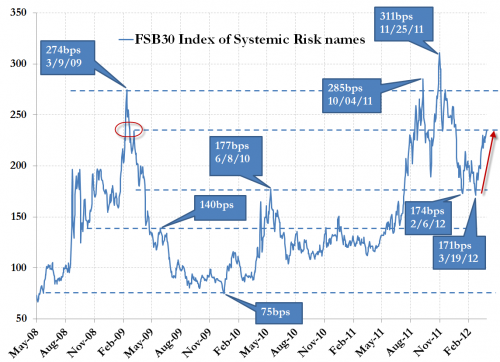
Further on yesterday's blog, and again via zerohedge, comes this chart by Capital Context. 


Zerohedge reports "At 235bps, the FSB30 stands just shy of the peak levels that were seen in the initial March 2009 crisis moment - though remains below Q4 2011 peak crisis levels. "

And this goes to the argument of yesterday.

But first up this is the 30 most systemically important global banks.  That is, they are large and therefore 'safe'.  They are also Too Big to Fail - or - will be bailed out should they make a colossal loss, because to allow them to fail would cause a systemic shock to the global financial system.  So 'safe', right.

Essentially by creating this list of TBTF banks, the regulators have created a run on any other bank in the world, but that is another issue.

But it begs the question of the Fed research in yesterdays blog - when it said that when interest rates are zero US (and global) banks have no financial incentive to put their money anywhere else other than park it with the Fed.  That research piece is a piece of shite. 

This graph shows that a bank who wanted to park its money in (okay this graph is in aggregate, but the point is made) a TBTF bank, it could be earning 25 basis points plus 235 basis points.  Or 2.6% rather than the 0.25% it earns at the Fed.

So there is an opportunity cost, and in todays world, quite a large one.  Using yesterdays data of funds parked with the Fed of US$1.5 trillion, the oppotunity cost to the banking sector (and shareholders) is US$32.25 billion. 

They are prepared to forfeit that revenue for the sake of capital security.  They simply do not trust the counter parties.  They are the ones with the insider knowledge.  And if they don't why would we? 


Right said Fed!

This graph commences in 1950 until the present time.  It measures the capital on the balance sheet of USA banks that is in excess to their requirements according to international prudential guidelines.  That is, capital not required (according to those measures) for them to run their business at optimal levels. More expressly, it is Excess Reserves of Depository Institutions (EXCRESNS), Monthly, Not Seasonally Adjusted, 1959-01-01 to 2012-03-01.  Clicking on the graph will give you a closer view. 


Since the GFC, and in prior forecasts, many people knew this was going to be a big one.  Crash, that is.  That we would be seeing volatility in data reads of extraordinary size.  But this one is just nuts. 

If you follow the blue horizontal line, you will see in late 2001 a tiny blip.  That was not long after the horrific terrorism attack in New York.  And in the few weeks that followed, at least several major US banks were bust so financially it was a very torrid time.

As you move further to the right, you will see that in late 2008 – about the time Lehman Bros was collapsing in the USA - banks started hoarding capital.  That excess now stands at about US$1.5 trillion.  In perspective, that is enough capital for another US$18.75 trillion worth of lending that they are not doing.  And that is of course how banks make profits, by lending out their money.  Well not strictly true any more, but theoretically correct.

Essentially they stopped lending to each other through the money market or interbank market because the view was trust no one.  So they started parking it with the Fed. 

By way of comparison, required reserves are about US$60 billion.  So in effect, these banks have 25 times their required reserves.  

So do they know something we do not?  Why hoard expensive capital, with the toll on profits given there is little place to invest it with much return, unless you are (i) scared out of your wits about another might downturn and massive liquidity crunch or (ii) there is a lot of short term risk (OTC derivatives?) they may have but we do not know, against which they are holding this capital (and not required by prudential standards).  There seems to be a complete loss of trust between counter parties.

Think about it this way.  You run a dairy that relies extensively on the power grid.  Now, occasionally that grid fails, so you have a large generator as a back-up.  Now just say, worst case, the generator wasn’t working, or may not work when required, and you are very cautious, then you may invest some money to have two generators on site.  As you run through this graph you will see that the US banks have the equivalent of 26 generators on the one dairy farm.  That is how cautious they are.

By any measure this is an astounding graph and data set.  And it tells us several things.  First, that the banks are scared out of their wits of the uncertain global economic future, so we should be too.  Second that if or when that hoarded capital starts hitting the streets as new lending, we are in for an almighty rise in inflation, whether in assets prices or consumption prices we should be prepared.  And finally, it really is different this time – but not for all the reasons you usually hear.  We cannot rely on how we each, as individuals, managed for our financial security in the past fifty years over the next fifty.  They will be defined as two different eras. 

Again, to provide another comparison, here is the Net Free or Borrowed Reserves of Depository Institutions (NFORBRES), Monthly, Not Seasonally Adjusted, 1959-01-01 to 2012-03-01.  As bad as things got in September October 2008, the borrowing was only minor compared to excess reserves achieved since then.  It was at about that time, that the Fed Reserve began, for the first time, to pay interest on the excess reserves that banks held with the Fed as the interbank market had pretty much collapsed.  In this they were copying New Zealand’s policies.


If you want the Fed’s research on these excess reserves you can read about it here.  It argues that the money market, which froze in 2008, has essentially been transplanted onto the Fed Reserve balance sheet.  Okay, that is my view of what they are saying.  That is rather than banks lending excess reserves to each other they now park it at the Fed.  

It also argues that when the short term interest hits zero, which it pretty much has, banks are no longer interested in lending out their money and thus generate excess reserves.  It says, “When the market interest rate is zero, banks no longer face an opportunity cost of holding reserves and, hence, no longer have an incentive to lend out their excess reserves.”  Not sure I agree with this, hasn’t anybody heard of risk spread to official rates?  

But it is more interesting when it gets to the topic of inflation.  It argues that because the banks are receiving interest (remember this is for the first time ever) from the Fed, then they do not have an interest in lending great swathes of money and thus creating great swathes of inflation.  It says “By raising the interest rate paid on reserves, the central bank can increase market interest rates and slow the growth of bank lending and economic activity without changing the quantity of reserves.”  The interest rate on both required and excess reserves is 0.25%.  

This must be having a discordant impact on the economy.  For a start the money is not being deployed to boost the economy; second, the people of USA are paying for these excess reserves through the Fed;  and finally, it should be called what it is:  a giant inflation creation.  

Or a great big fat dividend coming for shareholders??  Right said Fed. 

Wednesday, 28 March 2012

Failed policies keep repeating

There are three policies that are decidedly proven as failures.  Failure is measured in terms of making the financial / economic / social circumstances worse than they already were when the policy was applied.  Creating gross and widespread inequalities in wealth, education and income is a social example.  

The first is a trickle down policy.  That is, cutting the tax for the rich in the hope that they will spend more and give a boost to the economy.  The USA is the master at this so can provide decades of experience on which to test the policies success or failure.  

The second is austerity policies in times of economic contraction.  Well, there are more examples than you can poke a stick at:  Greece, Ireland, Latvia, Spain, England.  The outcomes are criminal in the effect this policy has on the population’s standard of living, the possibility for economic recovery, and long term decline in social cohesion.

And the third is self regulation.  A good example of this is the financial system.  Oh, you think it is regulated do you?  Nah!!  There are boundaries, such as Basle II (and soon (III)) and “rules”, but really it is then left up to the banks to monitor their own performance to these rules.  And then we have the global financial crisis in 2007 as a consequence.  So another example of proven failure with heavy costs to the communities continuing today around the world.  The grief in Ireland, Greece, Latvia, Spain etc etc would not be occurring if not for the monumental failure of self regulation in the financial system.

Now would you believe, even though these policies have proven to fail, in the last week I have come across new policies of each being implemented?  

Let’s deal with the last one first.  In Australia, the central government regulatory body – Australian Securities Investment Commission – chairman Greg Medcraft has done an interview that suggests that they are not really a regulator, but rather a co-regulator with the financial system.  He has a ''philosophical view that industry is generally best to self-regulate and, where possible, regulators can help to co-regulate''.  And gobsmackingly further “I've taken 'protection' out of our language because I think it's better to under-promise and over-deliver.  I think just saying you protect sends the wrong message; it's up to people to take responsibility for themselves, and we will certainly help to assist them in becoming confident and informed,''

Get it?  It is all your fault if you get spived. 

But we could have guessed that this would be his “philosophy” as he was Chairman of the American Securitisation Forum for the four years as they self regulated themselves into the GFC in 2007.  That’s right, the peak body overseeing the self regulation of the USA securitisation industry that blew up the financial world.  

We can deal with the first and second policy failures together.  Because, you guessed it, in the UK they are introducing both at the same time.  Both austerity AND trickle down tax cuts.  That is robbing the general population twice at the same time.

And as for robbing the poor to pay the rich, here it is – The Telegraph reports that GBP3 billion was taken from 5 million pensioners to pay (in part) for a 5p fall in income tax for high earners.  This despite a poll which showed that 2/3 of voters wanted to keep the top tax rate according to The Guardian.  

I have written before about the trickle down effect, how it creates massive disparity in wealth and income distribution as it gives to the rich, squeezes the middle class (downwards not upwards) in Trickle Up Trickle Down and Squeeze.  .  Further how it eventually leads to trickle up austerity, where Trickle up austerity is what you get when you unrestrainedly crush the middle class with trickle down policies and fail to restrain the rich with trickle up policies (taxing the rich and giving to the poor who will spend it and therefore expand the economy).  

And as for austerity policies in the middle of an economic contraction – the evidence this is wrong is wide spread.  And of course it flies in the face of the massive liquidity injections into the financial system that are intended to make its way into the economy but which are not.  Britain can expect its living standards to contract for another five years at least.  Especially as I have written that stagflation appears to have taken hold.  Rising costs of living against falling revenue / GDP. 

But it may be best written about in The Guardian with its six year scenario.  

This is what trickle down policies will achieve for the UK.  We know because it has already occurred in the USA.  Recent data from there is analysed in www.my.budget360.com – always an interesting read.  In 2010, the top .01% income was up 37% (or an average US$4.2m); the the remaining top 1% up 56% (US$105,637) and the bottom 99% up 7% (US$80).  And that was a good year.

Failed policies keep repeating themselves, and we let them.  Why?

Wednesday, 7 December 2011

President Obama backs the “trickle up” economic theory

Well I did not think my new economic theory would win such international renown in such a short space of time.  I wrote about the economic theory of the trickle down effect from tax breaks for the rich, and how it had without doubt failed completely as an economic policy.
I recommended that the USA adopt  my theory, which has been proven to work in boosting economic prosperity.  I termed it the Trickle Up effect. 
Obama, reaching back to Roosevelt, has come out in favour of removing the squeeze on the middle class, and taxing the rich.  Two days after my blog posting, maybe he is reading my blog, huh!
“… Obama's broader message was a sweeping call for the working class to get a "fair shot" and a "fair share" as he pushed for wealthier Americans to pay higher taxes and demanded that big corporate interests play by the rules.

"This is the defining issue of our time. This is a make-or-break moment for the middle class," Obama told a cheering crowd in a high school gymnasium in Osawatomie, Kansas.

"At stake is whether this will be a country where working people can earn enough to raise a family, build a modest savings, own a home and secure their retirement."

This is an important point, the financial and fiscal support for the middle class and lower earners.  It is they that make an economy work efficiently.  It is they that create jobs.  Companies don’t, rich people don’t, spenders do.  As I discussed in this blog.
It is not brain surgery.  You give the relief to that part of the demography that is most likely to spend it, thus encouraging growth in the economy, which drives more jobs for the un / underemployed, who because they too are in the lower income demographic will spend all their earnings as well. The rich [elites] benefit because the tide is rising for all.  It is a very simple cycle. 
And it works.

Monday, 5 December 2011

Trickle up, Trickle down, and Squeeze

I have written about this numerous times, but it still keeps raising its ugly head.  I am talking about the economic policy term called the “trickle down effect”.  This is a précis for supply side economics, which says in simple terms, “if we lower the tax for the high earning elites, their added expenditure will help the whole economy and job creation”.  It will trickle down, so to speak. 

This tax cut policy for high earners has been applied extensively over the last few decades to many of the western economies. And there is many things wrong with this theory.  First of all, it has now proven to be irrevocably wrong.  It has completely failed.  All that has occurred is the rich elite have been hoovering up the national income, and accumulating vastly greater swathes of wealth. And these countries’ economies are all near broke.

Second, there is a successful economic effect, that if you change taxes at the other end, that is, raising the tax free threshold on all incomes, it is proven that those at the lower end [I dislike calling it that, but means must], the multiplier effect on the economy is 1.75 times.  That is for every extra dollar a person on a low income gets, the economic impact is $1.75. This is because those at the lower income scale, are more likely to spend their additional money from tax savings and thus help the economy.

You read it here first; we are going to name that the “trickle up effect”. 

Yet every time a soft period in an economy comes around, there would be the pollies and lobbyists calling for cuts in taxes for high income earners to create the trickle down effect. Think Tea Party in America.  They are presently arguing that increasing taxes on the rich will undermine job creation.  [I assume that the elite will employ less cleaners, pool boys, chauffeurs, nannies, party organisers etc - many of whom are university graduates in law, accounting, physics, but can't get jobs].


Now lets look at this another way.

All over the world broke governments are intending to raise taxes, and especially on the wealthy or even the not so wealthy, such as landowners [Greece].  A couple of months ago the Economist wrote “The horns have sounded and the hounds are baying. across the developed world the hunt for more taxes from the wealthy is on.”´ This is exactly what they are meant to be doing as this crisis unfolds.  Are you listening USA??  This is how you pay the governments’ debts.  It is such sound and obvious good fiscal management, it should be done without thinking.

And it may come as a shock to many middle class it is you that is paying the piper.  Take Australia as an example. Due to bracket creep, over the next four years PAYG tax collections have risen from $140 billion per year, to $199 billion.  That is a 42% payroll tax increase, or 10% per annum.  And there are no tax cuts in sight, so they won’t be getting it back either.  This is broadly consistent with most [presently floundering] western economies.

The UK is another example, with its freeze on middle class public wages and adjustment on pensions announced in the Autumn Statement.

And unlike the Buffet Tax on the wealthy planned in the USA, this is paid by the so called middle class worker.  Let us call this effect the “middle class squeeze”. 

In Australia that tax rise “dwarfs the $8 billion minerals tax, this dwarfs the $8 billion carbon tax. Personal income tax collections will climb from 9.8% to 11.2% of GDP in four years.”  And yet there you have mums and dads in Australia running around saying “Don’t tax the big commodity companies, don’t tax carbon”.  Oh and Gina Rinehart Hancock, and Andrew Forrest of Fortescue Metals Group spent millions to stop those taxes as well.  [I am sure they won’t mind if I refer to them as elite earners, being billionaires and all]. Of course they don’t want a minerals tax.  Tax the working class instead. 

Has there ever been such a widespread delusion in the global population whereby the 99% work and vote against their own best interests?

And in case you are still not sure what is meant by the “trickle down effect”  it has been described this way: If you feed the horse enough oats, some will pass through to the road for the sparrows."  That is, if you give the rich enough money through tax cuts, maybe you will get some in the economy.  Good luck with that.